TIE-IN SOLUTION FOR PIGGING-COMPATIBLE GAS PIPELINES
An elegant tie-in solution was necessary for maintaining the piggability of main pipelines. Two 12-inch natural gas lines needed to be connected to a new well site near Pittsburgh. An innovative solution was used with TDW fittings and pig guide bars.
When maintaining the piggability of main lines was crucial, an elegant tie-in solution WAS necessary.

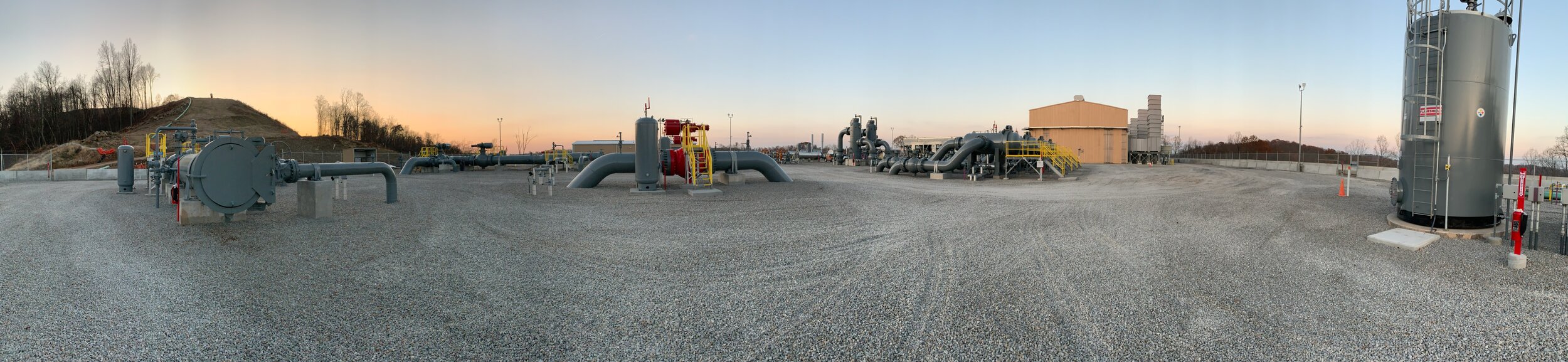
The job site with the two 12-inch x 12-inch 3-WAY™ Tee Fittings
Project Overview
A new natural gas well was being completed near Pittsburgh, necessitating the connection of two 12-inch lines from the well site to two 12-inch main lines. The 12-inch main lines needed to remain piggable.
Design & IMPLEMENTATION
To meet these requirements, an innovative solution using TDW 12-inch x 12-inch 600 class 3-WAY™ Tee Fittings with LOCK-O-RING® and pig guide bars was used. The LOCK-O-RING® completion plug features an interlock system that helps eliminate potential leak paths and ensures proper seating. The implementation process included:
Fitting Installation: The 3-WAY™ Tee Fittings were welded onto the 12-inch main lines.
Pipeline Connection: The 12-inch pipes with valves were welded to the 12-inch outlets on the fittings.
Hot Tapping: TDW service technicians performed two 12-inch Hot Taps.
Completion Plug Setting: The completion plugs with pig guide bars were set into the fittings by the TDW service technicians.
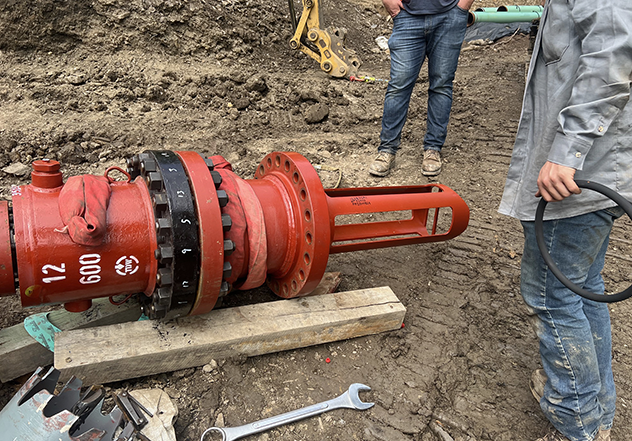
One of the completion plugs with pig guide bars

This approach allowed for the seamless integration of the new well site while maintaining the piggability of the main lines. By utilizing TDW's advanced fitting and plug technology, the tie-in solution not only met the immediate operational needs but also provided long-term reliability and safety for the pipeline system.
Kerr Engineered Sales Company has been representing leading pipeline repair and performance companies in Eastern US since the company was founded in 1952. Seventy two years later, the company remains a family business serving customers with the highest quality service and expertise.
Our application specialists at Kerr Engineered Sales Company are also available for demonstrations, team presentations, lunch and learns and customer visits.
TROUBLESHOOTING PIG-SIG V
PIG-SIGs detect pigs, spheres, scrapers, and other tools as they pass distinct points along the pipeline. They can also alert operators if a pig is lost or stuck. This blog has tips and solutions to the most common issues with the TDW Pig Sig V.
Tips, solutions and operating guide for issues with TDW Pig-Sig V.

Pig passage indicators are commonly referred to as “PIG-SIGs,” a term TDW originated more than 60 years ago. They accurately detect pigs, spheres, scrapers, and other tools as they pass distinct points along the pipeline and when they reach the receiver, and can also alert operators if a pig is lost or stuck.
The weatherproof and corrosion-resistant PIG-SIG® V pig passage indicator is built to withstand most environments. All components exposed to pipeline products are completely sealed to prevent leaks.

DOWNLOAD PIG SIG V OPERATIONS GUIDE
NOTE: It is very important to read these troubleshooting guidelines in conjunction with the Pig Sig V Operating and Maintenance instructions PIG- SIG V Guide
ISSUE: The Plug assembly won’t thread on to the THREAD-O-RING ™ Nipple
Verify that it is indeed a TDW THREAD-O-RING. The hole in the pipe may be too small or not centered. The TDW THREAD-O-RING may be swedged due to over-tightening of a valve or cap. Measure the inside dimension (ID) to ensure it is not swedged or egged.
ISSUE: PIG-SIG V has never worked correctly
Verify that the proper TDW THREAD-O-RING was used to correspond with the wall thickness of the pipe. Measure the height of the THREAD-O-RING as it is mounted to the pipe and then add that measurement to the wall thickness of the pipe. The measurement should not exceed 4.50 inches but needs to be greater than 4.25 inches.
ISSUE: The Plug stopped working correctly
If the plug is contaminated, install a new filter pack version. If there is wax build up in the plug: consult with the TDW factory regarding other plug options.
If The Trigger is damaged, the first step is to verify that the proper TDW THREAD-O-RING was used for corresponding wall thickness of pipe. Measure the height of the TDW THREADO-RING as it is mounted to the pipe and then add that measurement to the wall thickness of the pipe. This measurement should not exceed 4.50 inches but needs to be greater than 4.25 inches.
The plug may have wax or other buildup that is preventing the trigger from moving. This can lead to the plug being damaged.
ISSUE Electrical or Combo Electrical switch is not sending electrical signal
Check for the proper switch adjustment. Please refer to electrical switch instruction in the manual and ensure that the switch is adjusted properly.
Ensure that the double torsion spring is still installed correctly.
Verify that the indicator is properly installed. Check the indicator installation by removing a set screw and looking for the groove on the plug.
Verify that the plug is fully installed. Measure the distance the plug extends above the THREAD-O-RING Nipple; the distance should be 1 3/8 inches.
In the event of freezing weather, the seal on the indicator may have been compromised allowing water to enter the upper position of the plug. This water can freeze and not allow the magnet to move.
ISSUE: Indicator - The All Types Flag doesn’t raise after assumed pig passage
Verify that the indicator is properly installed: check indicator installation by removing a set screw and looking for the groove on the plug.
Verify that the plug is fully installed: Measure the distance the plug extends above the THREAD-O-RING nipple (should be 1-3/8 inches).
In the event of freezing weather: the seal on the indicator may have been compromised allowing water to enter the upper portion of the plug. This water can freeze and not allow the magnet to move. Remove indicator and check for moisture.
IN THE EVENT OF FREEZING WEATHER:
Remove indicator to check for moisture. 65 Section VII – Maintenance Table 11. PIG-SIG V Maintenance Intervals Item Interval Seal Inspect every six months for tears or cracks.
Replace annually (order seal kit).
Magnet Inspect annually.
Replace if cracks or chips are present.
Indicator O-ring is recommended to be replaced annually.
Plug O-ring Inspect any time the plug is removed. Replace annually.
Plug Backup Ring should be replaced each time the plug is removed.
NOTE: Times may vary depending on the pipeline product and the environment that the unit is exposed to.
ISSUE:Flag does not raise after assumed pig passage/switch does not actuate or release (reset)
Proper switch adjustment: refer to electrical switch instruction in the manual and ensure the switch is adjusted properly. The gap between polymer slider and switch plunger should be between 0.005 and 0.02 inches (0.1 to 0.6mm).
To discuss issues with your Pig Sig V please contact any of the KERR team.
Kerr Engineered Sales Company has been representing leading pipeline repair and performance companies in Eastern US since the company was founded in 1952. Seventy years later, the company is still a family run business serving customers with the highest quality service and support.
TDW Pig Parts - A Guide
TDW Pigs have various components. They come in a multitude of configurations. This blog reviews key parts that you’ll find on pigs and explains some of their uses.
TDW PIGGING INSIGHTS - Episode 4
Overview of TDW Pig Parts and Their Uses

TDW Pig Parts
TDW designs and manufactures an extensive selection of pipeline pigs for specific applications, such as liquids displacement, cleaning, batching, gauging.
Pigs have various components, and each pig comes in a multitude of configurations. This blog looks at some of the key parts that make up a pig and explains the uses of these parts.
pig PArts and their uses
Discs: Are effective at pushing out solids and providing a good support for the pig.
Conical Cups: Provide excellent sealing characteristics, good support and long wear.
Bypass Ports: These allow some of the flow to bypass through the pig and help minimize solid build up at the front of the pig.
Spring Mounted Brushes: Provide a continuous forceful scraping for removal of rust, scale and other build ups on the wall of the pipe.
Circular Brushes: The brushes are bi-directional and can be stacked for scraping for removal of rust, scale and build-ups.
Pit Boss/Pencil Brush: Scrapes deep into pits to remove build-ups.
Gauge Plate: For discovery of deformities/obstructions in the line, also commonly used prior to ILI runs.
Magnets: Pick up ferrous materials and give indications to loose debris in the line.
Learn more about TDW Pigs and Resources
TDW Pig Resource page.
If you have questions, please contact the Kerr Engineered Sales Company who are also available for team presentations, lunch and learns and customer visits.
Preparing & Filling Unisphere Pigs
In this third episode of Pigging Insights, we cover the steps and guidelines to preparing and filling TDW unisphere pigs. These seamless liquid cast polyurethane balls are designed for removal of liquid hydrocarbons and water as well as batch separation for pipelines handling different liquids.
TDW PIGGING INSIGHTS - Episode 3
Instructions for the preparation and filling of TDW Unisphere Pigs

TDW Unisphere Pig
TDW Unisphere pigs are seamless liquid cast polyurethane balls. They are designed for removal of liquid hydrocarbons and water as well as batch separation for pipelines handling different liquids. Unisphere pigs are hollow, they can be filled with liquid and also be inflated with pressure to match the pipeline’s ID.
Preparation for Use
Unispheres must be filled with liquid before use. Water/glycol or light lube oil solutions are recommended. It is best to avoid using pure glycol as a filling solution. The 4 inch to 8 inch Unispheres have one filling valve. Larger spheres have two valves; either valve can be used. Other components required are an inflating valve, valve core, pipe plug, filling adapter and valve core extractor.
Filling Procedure (not including inflating with pressure)
1. Remove inflating valve with a 3/8 in Allen wrench.
2. Fill sphere with liquid using funnel or hose.
3. The opening must be at the top and sphere completely filled with air displaced. Rolling the sphere slightly around can help to settle liquid and displace air.
4. Inspect O-Ring on inflating valve for nicks and burrs, and replace if necessary. Apply lubricant to O Ring and threads.
5. Remove pipe plug, and check the tightness of valve. A valve core extractor is available.
6. Install inflating valve and tighten securely.
The above steps are a guide designated to be read in conjunction with TDW Unisphere instructions. Download by clicking on the red button.
TDW PIG RESOURCES
Register for TDW’s e-commerce site and quick-ship Pigs.
To learn more about TDW Pigs or find Resource guides, see the TDW Pig Resource page.
If you have questions, please contact the Kerr Engineered Sales Company who are also available for team for presentations, lunch and learns and customer visits.