Iso-Smart™ Remote Asset Integrity Monitoring
GPT Industries is proud to introduce an all-in-one asset monitoring system! Iso-Smart™ is configured with 3 True RMS (TRMS) circuits to automatically test the effectiveness of your assets CP, Isolation, or the amount of current in your bond.
Iso-Smart™ Remote Asset Integrity Monitoring System

GPT Industries is proud to introduce an all-in-one asset monitoring system! Iso-Smart™ is configured with 3 True RMS (TRMS) circuits to automatically test the effectiveness of your assets CP, Isolation, or the amount of current in your bond.

By incorporating TRMS, users can also distinguish between DC or AC voltages and current. All to help keep you in compliance with regulations such as U.S. DOT’s PHMSA 49 CFR 192 and 195 (i.e. 192.463, 192.465, 192.467, and 195.49). This includes testing for:
On Potentials (asset potentials)
Instant Off (I-Off) Readings
Coupon Testing
Bond Monitoring
Isolation Monitoring
Watch the short film to learn about Iso-Smart™


For more information on any of the products or manufacturers we represent, please contact Kerr Engineered Sales Company.
Application specialists are available for team presentations, trainings, lunch and learns and customer visits.
GPT EVOLUTION INSTALL USES ZEVAC
A gas operator installing an 8in GPT EVOLUTION isolation gasket utilized ZEVAC to capture and recover vented gas. This made the operation emission free.
Gas operator installing 8 in GPT eVolution gasket UTILIZes ZEVAC TO MAKE THE OPERATION EMISSION free

Isolation gaskets are installed to protect lines from corrosion and unintentional leaks. Inmost cases, installing these gaskets requires sections of pipelines to be evacuated and purged, often by gas venting. The practice of venting creates intentional natural gas emissions, releasing methane into the atmosphere. It is a paradox to vent while protecting against leaks.
A gas pipeline operator in Pennsylvania needed to install an 8in GPT Evolution Isolation gasket at a well pad north of Pittsburgh. Instead of venting before installing and releasing emissions into the environment, they utilized ZEVAC services to capture and recover the vented gas. To draw down 200ft of 8in line from approximately 200 psi down to zero with ZEVAC took approximately one hour from set up to the point when the gas in the section had been re-compressed into an adjacent line.

Company personnel were then able to install the GPT EVOLUTION gasket. This gasket is fully encapsulated and just 1/8in thick for easy installation. The GPT EVOLUTION is extremely abrasion and impact resistant due to the proprietary coating. It is also fire safe and does not have lamination.
This project protected their pipeline and protected the environment.
For more information on GPT, ZEVAC or any of the manufacturers Kerr represents, please contact Kerr Engineered Sales Company.
Application specialists are available for team presentations, lunch and learns and customer visits.
GPT Isolation Gaskets – Matching to the Pipe Bore
Guide to understanding sizing for GPT Isolation Gaskets. A standard in gasket design for GPT is to match the gasket inside diameter (ID) to the pipe bore that the gasket is being put into.
A standard in gasket design for GPT is to match the gasket inside diameter (ID) to the pipe bore that the gasket is being put into. This is the appropriate sizing for most GPT gaskets.
GPT Isolation Gaskets
The flange bore will directly depend on how the flange connects to the pipe, and in general there are two ways – Weld Neck and Slip-On. Weld Neck typically means the flange is butt-welded to the pipe and in this case the flange bore will match that of the pipe bore. Slip-On means the flange is designed to slip over the outside of the pipe where it is then welded in place and therefore the flange bore will be slightly bigger than the outside diameter (OD) of the pipe. Knowing the type of flange is the first step to understanding the ID of the gasket needed. The goal is for the gasket ID to match the flange bore.
For a given nominal pipe size, the OD of the pipe does not change, but the pipe schedule changes and is related to the wall thickness (WT). The larger the schedule the ticker the pipe e.g. SCH 10 is thinner than SCH 80.
The gasket ID with a slip-on flange will be slightly bigger than the standard OD of a given nominal pipe size. For a weld-neck flange, the flange bore is the same as the pipe bore.
Wrong Sizing Leads to Corrosion & Erosion

It is important to understand why the gasket ID is required to be equal to the flange bore. For example, if the gasket ID was sized larger than the flange ID, the flange face and isolation would be at an increased risk as there would be a void between the two flanges causing increased turbulent flows of media. This increased turbulence can lead to crevice corrosion. There would also be an increased risk of unwanted media build ups in the void which could cause an electrical bridge shorting the path of isolation.
If the gasket were to be sized smaller than the flange ID, then the gasket would be protruding into the pipe, there is a risk of the sealing element landing inside the flange bore and not sealing against the flange face. The gasket would also be in the direct path of the media and pigs (both the pig and the gasket could be damaged). This situation again would cause increased turbulent flow leading to corrosion and erosion.
In the case of matching two flange faces with different bores, GPT best practice is to match the gasket ID with the larger flange bore.
In summary, matching the gasket ID to pipe bore is the effective way to mitigate corrosion and maintain electrical isolation.
The KERR team is available for presentations, lunch and learns and customer visits.
We at Kerr Engineered Sales Company know how important it is for operators to prevent corrosion and erosion when making purchase decisions and operating equipment. Kerr has been representing leading pipeline repair and performance companies in Eastern US since the company was founded in 1952. Seventy one years later, the company is still a family run business serving customers with the highest quality service and support.
GPT Preventing Electrical Bridging in Pipeline Isolation Joints
These resources help Oil and Gas operators meet the increasing demands and conditions such as sour gas.

In today’s Oil and Gas industry, increasing demands and conditions have become commonplace and are only set to continue as operators maximize and improve efficiencies in their processes. The increase in sour gas is one such example. Increased sour gas percentages are being experienced across the globe, presenting unique challengers to pipeline operators.
Sour gas can interact with moisture in pipelines and the metallurgy in the pipe to create Iron Sulfide known as “black powder”, a conductive material that can bridge isolation joints.
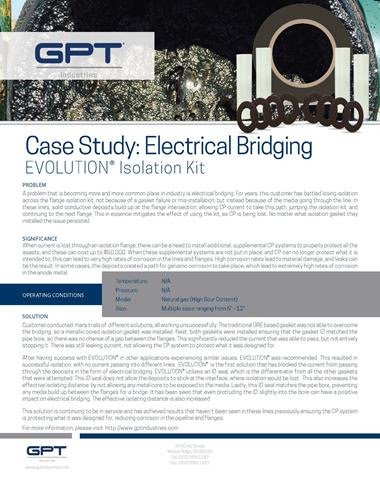
CASE STUDY: Overcoming Electrical Bridging with EVOLUTION®
For years, this customer has battled losing isolation across the flange isolation kit, not because of a gasket failure or mis-installation, but instead because of the media going through the line. In these lines, solid conductive deposits build up at the flange intersection, allowing CP current to take this path, jumping the isolation kit, and continuing to the next flange. Download the case study.
Download case study
Troubleshooting Common Failures with Isolation Kits
This webinar provides a unique insight into the most common failure modes of isolation gaskets and how to avoid and overcome these issues. GPT's application engineering team is exposed to various challenges and issues faced by corrosion professionals. In this interactive discussion, two of the most common failure scenarios are reviewed.
VIEW WEBINAR