Energy Transition: Technology Progress Report 2021
Ten technologies setting the pace of the energy transition over the next five years. A discussion of green hydrogen, for example, must account for developments in renewable electricity, hydrogen storage and transport systems, and end-use technologies such as fuels cells.
Ten technologies setting the pace of the energy transition over the next five years
There are ten energy systems technologies which must work together, quicker, to meet global decarbonization targets. This new report from DNV outlines these technologies forms part of their annual Energy Transition Outlook (ETO). While ETO forecasts runs to 2050, the Technology Progress Report focuses on the next five to ten years; this ‘technology decade’ will shape the long-term outcome of the transition.
10 energy transition technologies:
Floating wind - Developments in solar PV - Waste to fuel and feedstock - Pipelines for low-carbon gases - Meshed HVDC grids - New battery technology - Novel shipping technologies - EVs and grid integration - Green hydrogen production - Carbon Capture and Storage 2.0.

Click the photo to download
Kerr Engineered Sales Company has been representing leading pipeline repair and performance companies in Eastern US since the company was founded in 1952. Three generations later, the company is still a family run business.
Unsung Heroes - Natural Gas Operator Reducing Emissions
Instead of portrayed as a hindrance to climate change, forward thinking gas companies are fulfilling the role of enablers in the transition to renewables. In the Northeast, we see a strong commitment to reducing carbon emission from companies we work with in maintaining and enhancing pipeline safety and performance.
David Kerr, President and CEO, Kerr Engineered Sales

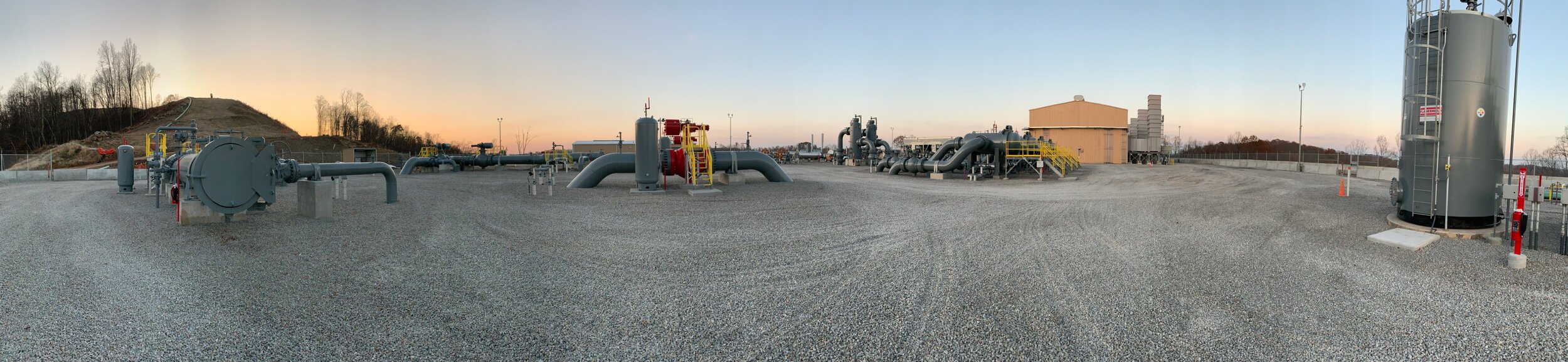
KERR Engineered Sales has supported this gas utility compressor station since the 1950’s.
Regardless of the way that natural gas is positioned in today’s news, the clean burning energy source remains a critical staple that meets a large share of electricity demand. Natural gas is absolutely fundamental for manufacturing in combined heat and power systems, as a raw material to produce chemicals, fertilizer, pharmaceuticals, plastics and more. It is clean, affordable and a vital source for heating and power generation throughout the US.
Instead of portrayed as a hindrance to climate change, forward thinking gas companies are fulfilling the role of enablers in the transition to renewables.
Behind the scenes, not in the headlines, pipeline performance commitments are fulfilled every day-by-day by utilities to ensure optimal performance, sustainability, and most of all safety.
“Natural gas is the "great enabler" for the energy transition because it is a reliable source of power that can backstop renewables. Gas is "low-cost, abundant, it's important in reducing the utilization of coal, and equally important in fostering renewables. You've got to be able to create baseload capability, and it addresses the enormous intermittency challenges."
- Al Monaco, CEO Enbridge Inc.
Yes, energy utilities and distributors are tackling the environmental and sustainability challenges at different paces. Some are already in transition and others are deep in planning and strategy. In the Northeast, we see a strong and steady commitment to reducing carbon emission in maintaining and enhancing pipeline safety and performance.
At a compressor station in rural Ohio, KERR Engineered Sales has supported a utility company for decades in improving performance and reducing emissions with upgraded equipment and process.
Compressor stations are a critical part of natural gas pipeline systems. Over 1,700 of these facilities aid the transportation process of natural gas from one location to another across the US. As gas flows through a pipe, friction and turbulence naturally slow it down. While natural gas is transported through a pipeline, it needs to be periodically pressurized at intervals. By compressing the gas, these facilities “boost” pressure in the pipeline and help move the gas long distances, or move it into underground storage facilities.
While adding more compressors to the station, the company upgraded the technology to stop using an inefficient water bath boiler unit that had high emissions. A BRUEST HOTCAT was installed to supply warm natural gas for the engines. The heater has zero emissions which allows the company to upgrade the performance while reducing emissions.

Bruest HOTCAT heaters upgrade performance with zero emissions.
The TDW STOPPLE ® procedure was used a few years prior to replace a leaking valve. The STOPPLE® allowed the company to isolate a small section of line to replace the valve. When leaky valves are replaced, emissions and gas leaks are prevented. By using bypasses along with a STOPPLE® application, customers have uninterrupted gas supply while the maintenance operation is being carried out.The TDW STOPPLE ® procedure eliminates the need to “blow down” a pipeline to carry out repairs.
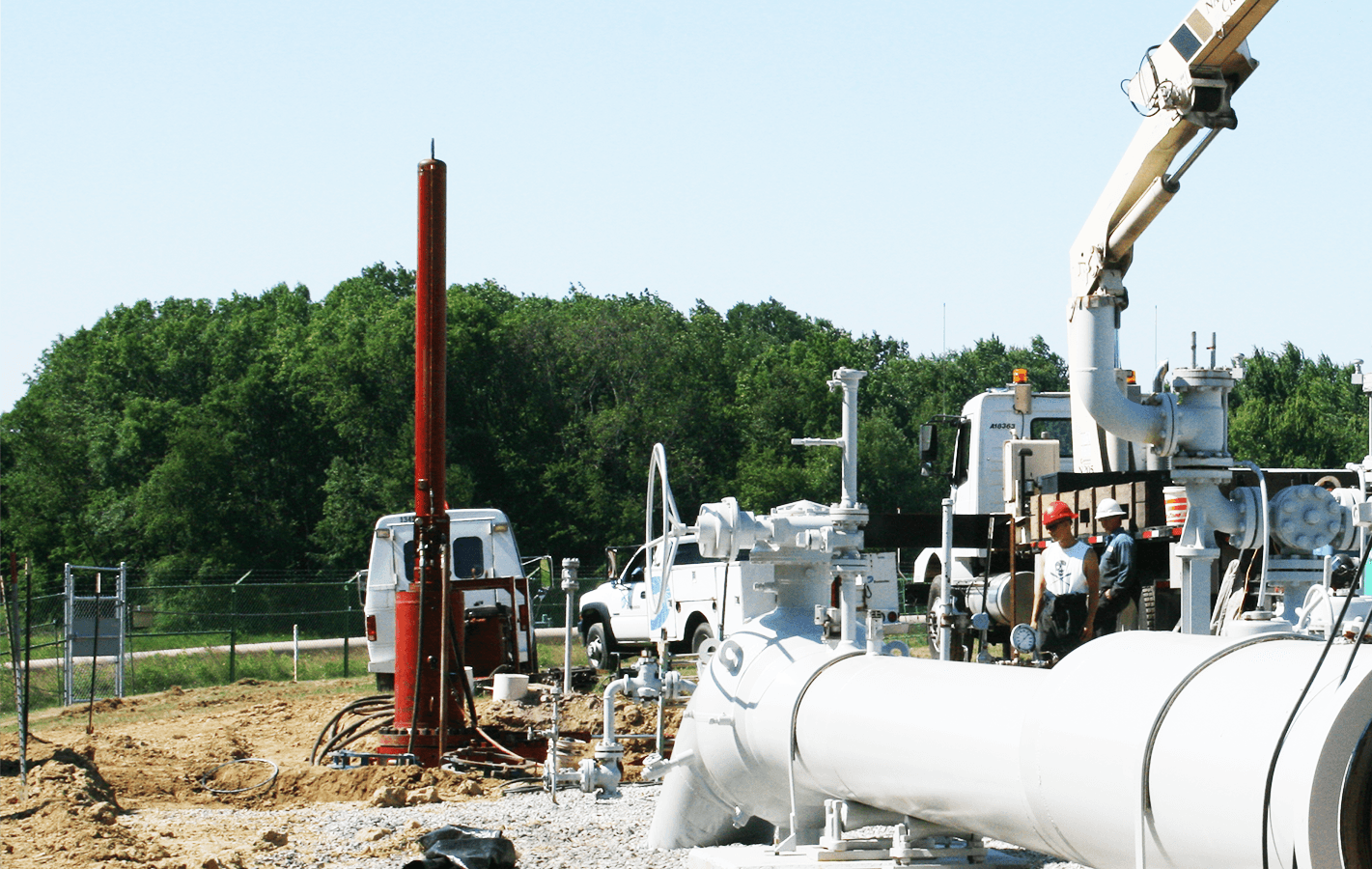
TDW STOPPLE® isolates a section of line for repairs while maintaining gas supply
Pipeline pressure has to be relieved in a natural gas pipeline for maintenance, testing and inspections. The company purchased an emissions reduction innovation developed by TPE Midstream. ZEVAC, (Zero Emissions Vacuum and Compressor. Instead of using a traditional “blowdown” method which releases gas from a pipeline to the atmosphere, ZEVAC uses compressed air to draw the pressure down on a section of the pipe and capture the natural gas so it can be re-compressed into an adjacent pipeline.

ZEVAC uses compressed air to draw the pressure down on a section of the pipe and capture natural gas to be re-compressed into an adjacent pipeline.
At the same compressor station, TDW pigs were used to clean a section of the pipeline. This included upgrading to a safer and more efficient closure, the TDW D2000, which was retrofitted onto the pig trap by cutting off the old threaded closures. KERR assisted with pig runs and In line Inspections (ILI.) ILI ensures that a pipeline is performing, identifies anomalies and measures the integrity of the pipeline.
These projects represent day-to-day pipeline performance commitments that utilities do every day to ensure optimal performance, sustainability, and most of all safety.

The TDW D2000 Quick-Actuating Closure is the most trusted in the industry
Gas utilities, like one in the northeast we’ve supported since the 1950’s, are delivering on initiatives to reduce emissions, while ensuring that consumers have a steady supply of clean natural gas. Gas flows in and out of pipelines that are monitored and maintained every hour of every day by unsung heroes who follow rigorous maintenance, safety and emissions compliance.
Kerr Engineered Sales Company has represented leading pipeline repair and performance companies in Eastern US since it was founded by Art Kerr, Sr in 1952. David Kerr is the President and CEO. He is a past Chairman of the Eastern Gas Compression Roundtable and holds memberships with Ohio Gas Association, The Energy Association of Pennsylvania, and the Guild of Ancient Supplers.
TDW's Role in American Pipelines Spans 100 years of Innovation
Chuck Harris, of TD Williamson, describes how two American pipelines, the Big Inch and Little Inch, helped meet wartime oil demand and aided victory in WWII. TD Williamson played a critical role in shaping the company as specialists in pipeline repair maintenance when asked to design a solution clean pipelines.
This article is from the December 2020 issue of World Pipelines
Chuck Harris, of TD Williamson, describes how two American pipelines, the Big Inch and Little Inch, helped meet wartime oil demand and aided victory in WWII. TD Williamson played a critical role in shaping the company as specialists in pipeline repair maintenance when asked to design a solution clean pipelines.

Art Kerr, Founder of KERR Engineered Sales & First US sales representative for TDW.
TDW ILI in Pipeline Under Cape Cod Bridge
As TDW Pipelines Services team recently proved on a project over Massachusetts’ Cape Cod Canal, there’s always a way to bring high challenges to a more manageable size. Ron Comer, Senior Application Specialist from Kerr Engineered Sales, facilitated this Boston bridge project.
Height makes managing the integrity of under-bridge pipelines complex and more difficult, with potential risk increasing inch-by-inch. When the bridge has an above-water clearance of 135 feet, accessibility may seem particularly daunting. As the TDW Pipelines Services team recently proved on a project over Massachusetts’ Cape Cod Canal, there’s always a way to break things down to a more manageable size.
As part of a structural integrity assessment, the operator of a 10-inch natural gas pipeline contracted TDW to clean and inspect a section affixed to the underside of a 1,408-foot bridge. The arch bridge carries foot, vehicular and bicycle traffic to the Cape Cod peninsula. The pipeline under it is one of three supplying the area, a popular vacation spot whose year-round population of about 215,000 more than doubles during the summer.

ILI tool being inserted into the pipeline under the bridge.
Because of the pipeline’s height, Pipeline Services couldn’t rely on typical equipment to launch and retrieve cleaning pigs or in-line inspection (ILI) tools. Instead, they employed a pull-through approach with wireline equipment. This method is frequently used for the controlled pigging of short segments such as water, highway or road crossings, for new pipe that hasn’t been connected into a system yet and for pipelines without launching and receiving equipment.
A Better Option
Height wasn’t the only challenge the operator and TDW had to consider. There was no access to insert or remove the cleaning pigs or in-line inspection (ILI) tools, and no way to install traps. Flow rate was another issue. Because the flow came from end-user demand on the line, there wasn’t much the operator could do to regulate the flow rate, which under normal circumstances, would keep the pigs and tools moving at optimal velocity.
To try to deal with these concerns, the operator initially considered using robotic remote- controlled ILI, but that idea was also fraught with problems. To reach the entry and exit points, the robot would have to make a 110-foot vertical climb on the inlet side. Not only did the vendor doubt the robot could pull itself straight upward, they were afraid that if the tool actually made it to the top it might make an uncontrolled drop on the descent. Direct inspection was also a thought, but that could be dangerous, expensive and time-consuming.
By contrast, the TDW wireline solution enabled the cleaning pigs and ILI tools to safely ascend into the pipeline and move through it at a regulated speed. The operation began with progressive pigging — a process of using increasingly aggressive cleaning pigs until cleanliness standards are met — to prepare the pipeline for good sensor contact during the ILI phase.
Safe, Successful Operation
According to Senior Field Technician Brandon Bolesky, who led the project, the first step was to provide entry and exit for the tools by removing a piece of pipe at each end of the section and replacing it with a blind flange with an attached valve. The cable from the wireline truck was attached to a tow pig in a disc cup disc cup (DCDC) configuration and pushed into the pipeline. Nitrogen pushed the tow pig through the line to the far end.
“We didn’t have a lot of information about the cleanliness of the line, so we started cleaning with zero expectations and adjusted as necessary, using increasingly aggressive pigs.”
After achieving the level of cleanliness required for a good ILI run, TDW ran a gauge pig to check for bore restrictions and then launched magnetic flux leakage (MFL) and deformation (DEF) technology in combination. Not only did the tools provide vital information about metal loss and out-of-roundness, dents and other geometric anomalies, running them together served a safety purpose: The MFL tool provided enough drag to prevent the possibility of it falling during descent.

Ron Comer, Senior Application Specialist from KERR Engineered Sales was the Application Specialist on this Boston project.
This article is reprinted from the October issue of Pigging industry News